Friday, June 23, 2023

GOD, MAN AND NATURE

 GOD, MAN AND NATURE 

by Kenneth Harper Finton, revised 2023


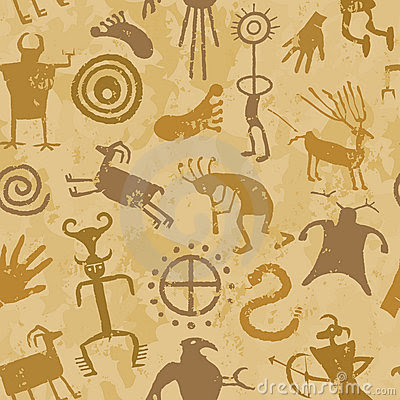
Since the dawn of time and certainly since the rise of self-awareness in the human race, people have contemplated the nature of the universe about them. The deepest thinkers among them have come up with many answers and visions from the same basic facts that underlie the material universe. The cave dwellers–writing on the walls–expressed in primitive drawings not only the facts of life that they saw about them, but their thoughts about the geometry of existence itself.


A certain unity of vision is capable of being expressed in numerous ways by simple contemplation itself. When one attempts to divide the world into its basic elements or contemplate the very nature of existence itself, thought runs smack up against the dualistic paradox of life. 


Democritus, a Greek philosopher developed the idea of an atom around 460 B.C. He asked:  “If you break a piece of matter in half, then break it in half again, how many breaks will you have to make before you can break it no farther?”  This smallest basic piece of matter he called atoms more than two thousand years ago. 


Democritus lived in a time when the earliest writing had been devised, so we knew what he thought. 


From symbols seen in cave paintings and pictographs, it would seem the cave dwellers from many thousands of years ago had already seen the symbolism of geometric shapes, as they drew them on walls and incorporated geometric patterns in their drawing and figures. 


Perhaps these geometric shapes are the foundations of existence itself, the first principles of being that existed everywhere at once–creating a quantum universe. Consciousness came upon and recognized its own beginning. It created time and space by devising an orbit. This thought is perhaps expressed on the wall of a cave many thousands of years ago. I see no reason why primitive man could not have come to a similar conclusion. Circles, points, and triangles are two dimensional representations of mathematical principles that were the first ingredient of being, thus becoming the first experiences.


Democritus tried to imagine the smallest pieces of matter, but later scientists found that atoms are broken into even smaller and smaller pieces.


Democritus’ theories were dismissed by Aristotle and were forgotten for two thousand years due to of the great stature that Aristotle held over his mimicking followers until the time of Newton.


When one attempts to contemplate the beginnings of all things and the endings of all things, paradox comes in to being. What is there before this world and this universe existed? What will there be after this world and universe ends? 


The answer, of course, is nothing. Yet, duality is an integral part of existence itself. The thought that nothing exists, shows that something exists in its very essence. [Thought and knowledge does not co-exist with the ultimate reality.] The nothing at the basis of the world about us, we discover, is of the soul of world and without essence.


Such thoughts sometimes lead us to a spiritual definition of nothingness that from even the most primitive times has been recognized as God or the Void, a unification of all that exists and a recognition that existence is, in its essence, non-material or spiritual.


As thought explodes and stills, the elusive basis of reality shines forth in the minds of those who contemplate. If nothing exists, then all is nothing and nothing is everything. If God is a spirit without form or essence, then God is present in every aspect of everything that exists. 


This is where contemplation leads us. It is how we interpret this emotionally that gives rise to our moral values and our feelings about ourselves and the world about us.


There is something in us that cannot tolerate paradox. 


If nothing exists, then that must mean that God does not exist. That leads to a denial of the spiritual essence that could forms the basis for existence itself. Such thoughts can  lead to a sense of forlorn isolation where nothing matters but the smaller self that we call our individual identity. We become the only thing that matters. These thoughts can  lead us to self-indulgence and greed. Much of the brutal history of the world was written by people who thought in this manner.


If, however, the spiritual essence of nature is accepted by the mind, then God not only exists, but everything is made of this spiritual essence and God is everywhere and in everyone. Yet, this in itself does not make existence any less problematic. Nature is not only gentle, but violent. Mythologies are constructed to explain what we see as evil and good in the essence of the world about us. Because we, as humans, name and value things, we force nature into shapes and patterns that we can comprehend and create a world of good and evil–even if all things are in essence spiritual. No wonder we live in a world of black and white with many shades of gray. We have created such a vision from placing our values on experience itself.


That the universe was formed without such human values and that experience is the true reason for existence seems a strange and perhaps irreverent idea. Many rebel against this reasoning. Many want to believe that the spiritual nature is essentially good–even divine–and something went astray in the world that produced the terrible things that we experience and see around us. That is the way we escape taking responsibility for what we see as evil in the world. 


Is there no other way to view this dichotomy? 


If we are all spirit in essence, then we would all be God and the world would be like Heaven on Earth. Yet, it is not. Does this prove that we are not all God? Does this not prove that we are not, in essence, a spirit?


When we look deeper into this, we can see that good and evil is simply another pattern of opposites that form the basis for existence and experience itself. Change is built into the world by time and space and the forming of structures that are never permanent by both design and necessity. Change imposes a beginning and an ending. Both are an illusion and temporal. Place a value on change–call it life and death, good and evil–it is still a temporal illusion.


If a spiritual essence is the basis for the universe about us and experience is the reason for this essence to be, then we are indeed one with the world about us and only our self- aware identities stand in the way of knowing the ultimate reality of all things. If the only time is now and all things are present and exist in the now, then many things we thought we knew about this world are false. 


It is not that we need deny the idea of a past, as change itself leaves traces of the previous states that were experienced by material things that are no longer existent. It is not that we cannot plan a future, as the future is created from the probabilities that are inherent in the now and have not yet been experienced.The world is still what we make it to be. 


Our thoughts are both extremely important in the experience of the now and the possibilities that we project for the future. We should start again to develop a better system of social and communal life that recognizes the essence of all things as being a unified field of being. 


Thursday, June 22, 2023

THE SEARCH FOR TRUTH


 THE SEARCH FOR TRUTH


by Kenneth Harper Finton, revised 2023


There is in us something that causes us to perpetually search for the truth. I have learned not to trust anyone who tells me they possess the truth. I have no doubt they think they do possess truth, but this thinking of theirs does not make it so.

A myth is a widely held but false belief or idea. Myths are associated with traditions and religions. There are twelve major religions in the world today–Baha’i, Buddhism, Christianity, Confucianism, Hinduism, Islam, Jainism, Judaism, Shinto, Sikhism, Taoism, and Zoroastrianism––and all of them have adherents who think they possess the truth.

That alone shows us that truth is subjective.

Religions serve many purposes, but three main human longings form the basis for the hold of religion over the populations: 1) the thought of death 2) the purpose of living 3) the advancement of social constructions.

We, like most of the spectrum of living things, have an instinct for survival. Self-aware humans realize that they will perish from a very early age. People often accuse young people of feeling that they are immortal, but nothing could be farther from reality. They come upon the realization of their potential demise early on and are often highly troubled with the thought.

It is understandable that we wish to continue as long as possible, but sooner of later, we will come to realize that nothing lives forever. We find that fact to be depressing and begin to wonder what the purpose of life really is. “Why,” we ask, are born but to die?”

Enter religion and mythology, often from 'stage fright'.

Afterlife––concepts of heaven and hell, the idea of eternity Nirvana or unity with the void––are common components of religious belief.

Some people desperately want to believe that they and their loved ones can persist long after their time on Earth has come to an end. Religions and individuals develop mythologies to satisfy this deep-set urge to persist and continue their personal identities in another place and time. In scientific circles, ideas of multiple or alternative universes where other forms of ourselves exist in other planes seem to satisfy the need for perpetuation in some people. After all, in infinity are not all things possible?

Potentiality, however, is not the same idea as possibility. It behooves us to remember that infinity is in another dimension. In nonexistence nothing at all is possible. Again, we meet with duality and the limitation of expression. If nothing is possible in nonexistence, then the possibility of nothing existing is absolute. Nothing does exist and our world is living proof it it.

Since we obviously have an identity, then we exist and therefore we are not Infinite. We are temporal beings. The price of existing seems to be the possession of a beginning and an ending.


It is hard to fault people for these beliefs. It seems so natural to want to persist through eternity, despite the likelihood that we would grow so bored and stagnant that we would want to curse of our immortal existence after an unreasonable amount of time had passed.

Too many wonderful lives end too quickly in our short life spans. It is the stuff of tragedy, confusion and the ingredients for despair. Our emotional human natures call out for a scape goat for the horrid things that happen to us and those around us.

The first in line for blame is generally God, the Devil, or Mother Nature–social constructions that we have made to explain the harshness of reality in our short, unhappy lives. Religions teach us not to blame God for the evils that occur, but many allow us to blame the Devil. Mother Nature is concerned with nurture and growth, so she is not to blame in many religious dogmas.

So what if the Earth opens up and swallows us whole or the currents sweep away the innocent child. So what if the tornado cripples the town or an accident breaks the back of the best athlete your village has ever known, turning him into a paraplegic vegetable. It is not the fault of Mother Nature. It is not the fault of God. “Who are we to know the ways of God,” is often the answer we are forced to swallow.

Satan is the ultimate scape goat in the Judaic/Christian belief system. There is something in us that wants to define and personalize evil and hate. What better construction for the ages than to have a benevolent and caring father figure at war with the unholy forces that cause harm to ourselves and our loved ones?

Thus we build our myths. God, the father, is built upon the structure of the nuclear family. Satan is the source of all evil.

So what is the reasonable explanation? What new myths should we construct to explain the inhumanity of man to man and the eternal war against the mechanisms of nature? Shall we create a myth of alternative universes or parallel worlds? Should we speculate that in infinity all is possible, including the recording and storing of all identities and experiences? Surely this is a possibility, as in endless time most all potentiality becomes possible.

If the world itself is a myth, then we cannot help but generate new mythologies no matter how scientifically rooted our knowledge becomes. We can only speculate upon the reason, if any, for existence to be apparent. The big question of why there is anything at all when nothing would do so well is answered with the realization that nothing is real and all is illusion.

Yet, there is the question as to why a world, be it real or illusion, exists at all. The answer, of course, is that it does not exist. There is only experience and the awareness and consciousness that makes that experience possible.

Infinity is unknowable. Perhaps consciousness itself is at times without experience. It contains no mass nor matter nor energy. Infinity has no place in time, no place in space, yet it is the source of all things when things become manifest and worlded. Yet, mathematical patterns and physical laws that govern the interactions of things perhaps precede existence itself, a part of dimension zero itself..

Infinity precipitates all things. Nothing becomes real, though nothing is real. Once experience begins there is no stopping it. Once movement defines space and contains enough duration to be felt and observed, an entire universe is born.

Experience itself might be the purpose of the observable universe, if it must have a purpose at all. However, there is no need for a purpose. Purpose is a human construct and value. Why would the universe need a purpose? Experience is in itself enough. Experience preceded our human values and will succeed and outlast our values.

The human mind is born without experience. Experience is learned from trial and error. Would not the universe itself, born without experience, do the same?

What happens if experience comes to an end? What happens if all motion is stilled and all space and time disappears? Does the universe itself end? Will experience begin again as it did in a beginning?

Or did it never begin in the first place?

The only way out of the conundrum is the latter. It never did begin and it will never end because it did not begin. This thought, or this lack of thought, is the only logical answer.  

If experience is the source of all events, all events are experience. They carry no blame, no cause, no system of evaluation. Being is for the sake of being and all things that we emotionally react to are not purposeful, but essential for the experience of being.

How, we might ask, could it be any different? I can see no way that it could be different. As in life we have to deal with the good and the bad, the evil and the good, so does the universe at large.

You might ask yourself what you would change if you were in charge of designing the universe. If you were the creator of all things, what would you change? Would you make things so all beings live forever? Would you eliminate pain and suffering and man’s inhumanity to man? Would you prefer the constant temperance of a summer’s day to periods of tornados, hurricanes, earthquakes and tsunami waves? These are things we have learned that we would like to control. We can design and protect against these things at the present time.

Personally, I would make a small change, should I design the world. I would prefer that dogs live as long as their we do. I have always found it absurd that elephants and parrots and turtles have century long lives while dogs are lucky to make it to age fifteen. Genetic science might create long -lived dogs. Yet, even that might be too much to ask, for by loving our pets and losing them, we are prepared for greater sacrifice and sorrows to come later. If we are to live in this world of gain and loss, we must experience both. So it is with the universe at large.

The world changes about us and we change with the changes. The sun shines on all and the rain falls on everyone. Some of the most destructive forces in the universe have created the temperate planet on which we live today. The Earth itself was struck by a sister planet the size of Mars about three and a half billion years ago. That collision almost destroyed the Earth, but without that occurrence, we would have no moon.

Without the moon we would have much smaller tides only pulled by the Sun. We would have much shorter days of between four and eight hours of daylight. We would have much longer years because it would take well over a thousand days to orbit the Sun. We would have much darker nights with our shortened days without the reflected moonlight to shine upon the planet. Without that cosmic cataclysm life would be much different on Earth, if it existed at all.

A universe without change would be impossible, as change is inherent in the very design of movement. Movement begets change. Change begets loss. Loss begets sorrow, sorrow begets new joys.


Friday, August 21, 2020

COSMIC ORIGINS

 COSMIC ORIGINS


Scientists tell us that the universe was born about 13.8 billion years ago. Through the eons that passed, our modern lives evolved from nothing into the complex situations that we find ourselves immersed in and call the present time. Everyone seems to have a theory of why this is so. Some ideas seem much better than others, yet all lead that same demise that our emotional states want desperately to reject, the cessation of being itself. 

We try to contemplate the nature of the world—develop ideas about the building blocks of nature that create this world around us—by looking into the atoms that make our physical universe searching for the smallest particles.

Is there such a thing as the smallest particles? How could there be? Something would always be smaller than the smallest until it disappeared into infinity—which is exactly what matter seems to do. 

Matter seems to be made of vibrating wave frequencies. Electrons have different states of energy. We see solidity in our immediate world, but the micro world seems to be a sea of informational energy that creates the appearance of solidity, while most of the manifest universe is a vacuum in space. We do not live in the micro-world. We know that if we crash into these solid mountains of elemental rocks, it will injure or destroy us. 

Donald Hoffman—professor of cognitive science at the University of California, Irvine—wrote: "On the other side are quantum physicists, marveling at the strange fact that quantum systems don’t seem to be definite objects localized in space until we come along to observe them—whether we are conscious humans or inanimate measuring devices. Experiment after experiment has shown—defying common sense—that if we assume that the particles that make up ordinary objects have an objective, observer-independent existence, we get the wrong answers. The central lesson of quantum physics is clear: There are no public objects sitting out there in some preexisting space. As the physicist John Wheeler put it, “Useful as it is under ordinary circumstances to say that the world exists ‘out there’ independent of us, that view can no longer be upheld.”


Hoffman continues: "Not only are they ignoring the progress in fundamental physics, they are often explicit about it. They’ll say openly that quantum physics is not relevant to the aspects of brain function that are causally involved in consciousness. They are certain that it’s got to be classical properties of neural activity, which exist independent of any observers—spiking rates, connection strengths at synapses, perhaps dynamical properties as well. These are all very classical notions under Newtonian physics, where time is absolute and objects exist absolutely. And then [neuroscientists] are mystified as to why they don’t make progress. They don’t avail themselves of the incredible insights and breakthroughs that physics has made. Those insights are out there for us to use, and yet my field says, “We’ll stick with Newton, thank you. We’ll stay 300 years behind in our physics.”


In other words, Hoffman thinks that the universe itself if a mental conception composed of independent conscious agents with varying degrees of complexity, all of which are but informational viewpoints that communicate with one another. From the smallest to the largest, all are composed of the same non-material—awareness and consciousness. Communicating conscious agents can merge to form other conscious agents.


DOES IT MATTER?


Does it matter much if the universe is a mental conception or a physical reality? Are the results not the same? Both lead to the same questions and dilemmas either way. Saying that nothing really exists does not change anything because it still exists. Notions that awareness can sleep, wake, be unaware, and dream again through infinity is the most interesting mythos. 


Can an understanding of the cosmos as a mental conception be an emotional solace to existential anxiety?


Life becomes one riddle after another for the thinking person. Solving one riddle creates many more to take their place. Debunking one myth leads to another, as the world is both mystic and mythic.


We peer into the universe with our telescopes and our probes and find awe-inspiring beauty of all kinds. Who can object to the beauty of Saturn's rings set in the blackness of the sky or the wonderful things that nature provides for our eyes and ears to hear and see? At the same time, we wonder why these things even exist for us to see. Why should the beauty of the world go unseen and unappreciated for billions of years, waiting to be seen and appreciated for billions of years while intelligent life on Earth evolves enough to care about it? Who or what experienced these wonders before the dawn of time or the emergence of living things? What was the observer that brought our universe into view?


This is where the idea of a mental conception of the world is most convincing. In order for there to have been an evolutionary past through the birthing of elements in stars, there had to be an observer.


Many believe that God is the creator of the universe and experienced the void of the universe alone long before the world came into being, but everyone has their own conception of what this God might be. The Abrahamic religions give God a male gender, a father figure—though giving birth to the universe seems to be a female attribute. Cultures create their own myths to explain their existence.


In the long run, does it matter whether God created the universe (as some religions claim) or physicality came into being and evolved into the present (as some scientists believe). Either point of view is obsolete with quantum mechanics. Yet, both views point to an event from an undefinable zero dimension. Whether we call it Creation or the Big Bang, we refer to the same event that came from beyond time and space. 


Some assume our universe came from the remnants of a previous universe. Some think it came from nothing at all, and some say something cannot come from nothing. 


I, for one, find it much easier to visualize timelessness than to envision the beginnings and endings of time. I also find it easy to visualize timelessness as having no concept of duration yet is focused on experience instead. The timelessness of the dimensions above our own experience seems to perfectly balance our mortal experiences with the immortal potential of our existence. Duration is a concept stamped upon experience by intellectual branders. Someone dreamed up the idea of measuring time but did not really comprehend the nature of timelessness and pure experience. How long the experience is felt is not nearly as important as the experience itself.


Saturday, July 30, 2016

DIMENSIONS: THE BUILDING BLOCKS OF THE UNIVERSE

Einstein recognized four dimensions, length, width, height and space-time. Since our eyes only see three in three dimensions (they cannot see space and time) comprehending the additional dimensions is both difficult and theoretical. Modern scientific theories call for at least ten dimensions, possibly as many as twenty-six or even an infinite number of dimensions. Though there is little agreement among scientists as to the natures of the additional dimensions, they are confident that there are more than four. Ancient Vedic texts speak of sixty-four dimensions long before modern science and mathematics was envisioned.


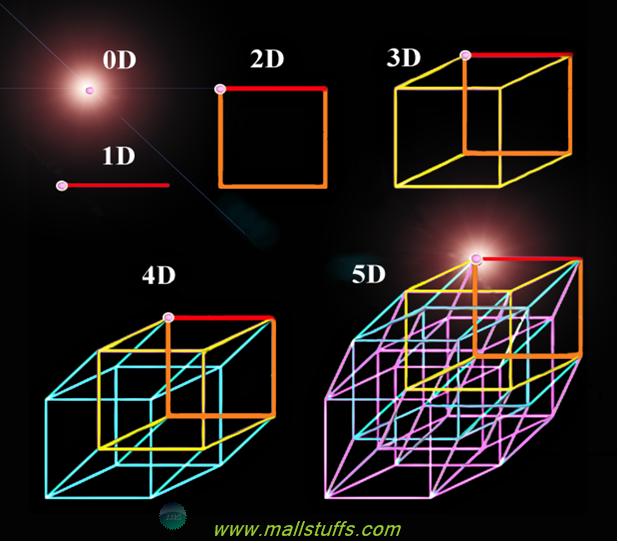
In zero dimension there are no measurements, but the zero also contains the point or the dot. It is the zero  point. No numbers are needed to identify its position. The point is infinite in that it is present everywhere at once with no time, spacial measurements or observation needed. Zero dimension is thus infinite, as is the first dimension of the point.

Whywecannotseegod0.png

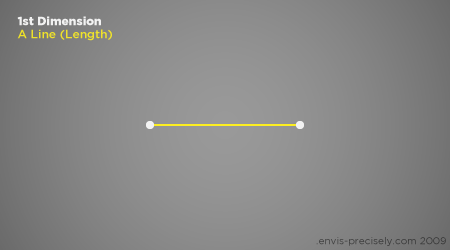
The first dimension gives birth to the line. The line contains an infinite number of points. The line is symbolic of the future. The awareness inherent in the zero dimension creates a symbolic future, that forms a trajectory. Two dots are needed to define a line. Any other of the infinite dots on that line can be located on that line using one number. We can observe the distance to the second dot to the zero dot by using the distance between them as a unit of measurement. On a ruler, the first dots can be at 0 and the second dot is at some measurable length from the 0.

The second dimension is the plane. It contains an infinite number of straight lines. The second dimension represents the present or the now. We need two numbers to identify a point on a plane. Mathematicians call these the ‘x’ and the ‘y’ axis. The illustration represents four dots connected on a plane.

6-dimensions-of-user-interface-design-1st-dimension-a-line-length

The third dimension is where energy observes itself and congeals into matter. This is the plane where thought and mind come into play. To understand this, we need to realize that thought and mind are universal entities, not simply products of organic nervous systems. We need to understand that awareness and the unconscious mental processes are essential to the manifestation of actuality itself.

The third dimension is the plane where awareness observes the flatness of the first two dimensions and projects it into objects and events. In the third dimension, three numbers determine the distance of an object in space. These are usually called ‘x,’ ‘y’ and’ z’. The third dimension is observed from above the plane. The operating word here is ‘observed’. Without the unconscious awareness observing an object from above, there can be no third dimension and no object to observe.

3 dimension

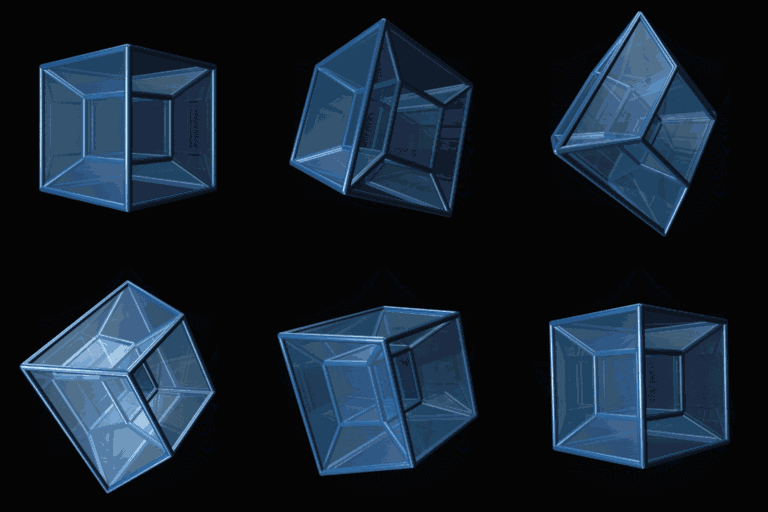
The fourth dimension is space-time. This is the dimension that we live within. Four numbers are needed to place an object in space-time. Three of these numbers set the position in space, and one of the numbers give duration for setting the time. We live in a four-dimensional world. The fourth dimension is the gateway to universal formation. Space-time is the unification of time and space as a four-dimensional continuum as in Minkowski space, the mathematical setting for special relativity.
Simple4C
The fifth dimension is where possibility begins. The fifth dimension begins the building of universal imagination. Images-in-action appear in this dimension, as unconscious awareness begins to imagine other possibilities and other possible events and different potential worlds.

five-dimensional space is a space with five dimensions. If interpreted physically, that is one more than the usual three spatial dimensions and the fourth dimension of time used in relativistic physics. It is an abstract which occurs frequently in mathematics, where it is a  legitimate construct. In physics and mathematics, a sequence of N numbers can be understood to represent a location in an N-dimensional space.  The geometry of the fifth dimension studies the invariant properties of such space-time, as we move within it, expressed in formal equations.


Mixed_by_La_Truffe_-_4th_Dimension.gif

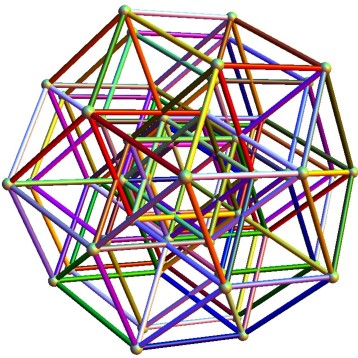
Six-dimensional space is any space that has six dimensions, that is, six degrees of freedom, and that needs six pieces of data, or coordinates, to specify a location in this space. There is an infinite number of these, but those of most interest are simpler ones that model some aspect of the environment. Of particular interest is six-dimensional Euclidean space, in which 6-polytopes and the 5-sphere are constructed. Six-dimensional elliptical space and hyperbolic spaces are also studied, with constant positive and negative curvature.


6Cube-QuasiCrystal

Beyond the fifth dimension, dimensions are imperceptible to our senses. They are highly theoretical, mathematical in nature.  That is to say, equations can describe them but we cannot see them.

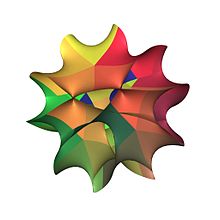
The existence of extra dimensions is explained using the Calabi-Yau manifold, in which all the intrinsic properties of elementary particles are hidden. If the extra dimensions are compacted, then the extra six dimensions must be in the form of a Calabi–Yau manifold (shown below). While imperceptible as far as our senses are concerned, they would have governed the formation of the universe from the very beginning. Hence why scientists believe that peering back through time, using telescopes to spot light from the early universe (i.e., billions of years ago), they might be able to see how the existence of these additional dimensions could have influenced the evolution of the cosmos.

CalabiYau5
Seven-dimensional space in mathematics is a sequence of n real numbers can be understood as a location in ndimensional space. When n = 7, the set of all such locations is called 7-dimensional space. Often such a space is studied as a vector space, without any notion of distance. Seven-dimensional Euclidean space is seven-dimensional space equipped with a Euclidean metric, which is defined by the dot product.

More generally, the term may refer to a seven-dimensional vector space over any field, such as a seven-dimensional complex vector space, which has 14 real dimensions. It may also refer to a seven-dimensional manifold such as a 7-sphere, or a variety of other geometric constructions.

Seven-dimensional spaces have a number of special properties, many of them related to the octonions. An especially distinctive property is that a cross product can be defined only in three or seven dimensions. This is related to Hurwitz’s theorem, which prohibits the existence of algebraic structures like the quaternions and octonions in dimensions other than 2, 4, and 8. The first exotic spheres ever discovered were seven-dimensional.


Another theory, I believe false, about the seventh dimension is that it grants access to the possible planes that start with different initial conditions and other points in space-time than our own. A point in the seventh dimension consists of all the possible worlds that start with the different initial conditions from our own space-time and leads to all the possible endings to which such an initial condition can possibly go. In the fifth and sixth dimensions, the initial conditions were the same as our own space-time and subsequent actions and events were different. In the seventh dimension, everything is different from the very beginning of time.


Eight-dimensional space, in mathematics, is a sequence of n real numbers can be understood as a location in ndimensional space. When n = 8,  the set of all such locations is called 8-dimensional space.

Often such spaces are studied as vector spaces, without any notion of distance. Eight-dimensional Euclidean space is eight-dimensional space equipped with a Euclidean metric, which is defined by the dot product.

Generally, the term may refer to an eight-dimensional vector space over any field, such as an eight-dimensional complex vector space, which has 16 real dimensions. It may also refer to an eight-dimensional manifold such as an 8-sphere, or a variety of other geometric constructions. See: https://en.wikipedia.org/wiki/Eight-dimensional_space

The ninth dimension is unknown It is falsely described as containing all the possible universes and histories whether or not they shared the same starting point in space-time and includes all the possible laws of physics and initial conditions.

The tenth dimension is the point in which everything possible is contained. It contains the history and records of all that has ever existed.


Monday, June 1, 2015

THOUGHT

by Kenneth Harper Finton ©2015

A UNIFIED THEORY OF BEING   "A human being is part of the whole called by us universe, a part limited in time and space. We experience ourselves, our thoughts and feelings as something separate from the rest. A kind of optical delusion of consciousness. This delusion is a kind of prison for us, restricting us to our personal desires and to affection for a few persons nearest to us. Our task must be to free ourselves from the prison by widening our circle of compassion to embrace all living creatures and the whole of nature in its beauty...We shall require a substantially new manner of thinking if mankind is to survive." - Albert Einstein      


220px-Thought_bubble.svg


THOUGHTS
Unconscious thought needs no brain to advertise its presence.
Thought brings to light a spark, impulsive waves that create space
and burns its way through time to start the clock of matter.
All matter thinks, as all movement is preceded by thought.
All life thinks, as life is thought made manifest in form.
All of nature thinks, as all of nature is ruled by physical laws.
We see it in the movement of the wind,
We see it in the birthing of desire,
We see it in the crackling of a fire.
Even the cosmos is a living, breathing being
that looks endlessly to propagate and create
and sifts through infinity itself to find its better half.

Our self-centered, self-reflecting species has come to believe that we are the only thing that thinks. Despite the fact that plants seek the sun and tendrils wind their way up and down, despite the fact that insects show intelligence and microbes show awareness, our limited definition of thought has hidden the truth of the world from us. We have equated our brains with our intelligence and our nervous system with our thoughts. It has not occurred to us that thought precedes essence, that the spark of thought ignited the entire big bang that we theorized made the universe itself.

All movement is preceded by thought. It is thought that causes movement. Without movement, we can have no space nor time, nor existence. We can experience the truth of this statement within our own selves. In order to do something, we must first contemplate and think about it–even if the thought is unconscious thought.

 What is thought?

 The word thought comes from Old English þoht, or geþoht, from stem of þencan "to conceive of in the mind, consider." [Harper, Douglas. "Etymology of Though." Online Etymology Dictionary.]

Noesis (n.)

1820, from Greek noesis "intelligence, thought," from noein "to have mental perception," from noos "mind, thought."

Mind (n.)

late 12c., from Old English gemynd "memory, remembrance, state of being remembered; thought, purpose; conscious mind, intellect, intention," Proto-Germanic *ga-mundiz (cognates: Gothic muns "thought," munan "to think;" Old Norse minni "mind;" German Minne (archaic) "love," originally "memory, loving memory"), from PIE root *men- (1) "think, remember, have one's mind aroused," with derivatives referring to qualities of mind or states of thought (cognates: Sanskrit matih "thought," munih "sage, seer;" Greek memona "I yearn," mania "madness," mantis "one who divines, prophet, seer;" Latin mens "mind, understanding, reason," memini "I remember," mentio "remembrance;" Lithuanian mintis "thought, idea," Old Church Slavonic mineti "to believe, think," Russian pamjat "memory"), meaning "mental faculty" is mid-14c. "Memory," one of the oldest senses, now is almost obsolete except in old expressions such as bear in mind, call to mind. Mind's eye "remembrance" is early 15c. Phrase time out of mind is attested from early 15c. To pay no mind "disregard" is recorded from 1916, American English dialect. To have half a mind to "to have one's mind half made up to (do something)" is recorded from 1726. Mind-reading is from 1882.  

 Thought has been linked with the mind since the beginning of language and human communications. Consciousness is also related to the mind, as consciousness is the state of being aware of one’s own existence. Our physicists envision a singular spot of infinitely dense particles with indescribable temperatures where all particle once congregated in unfathomable density before exploding in the big bang. Have we failed to comprehend that it was the spark of thought that preceded the observed reality of existence and started the interconnected chains of experience that became our universe.

Experience

[ik-speer-ee-uh ns] noun 1.   a particular instance of personally encountering or undergoing something: 2.   the process or fact of personally observing, encountering, or undergoing something: 3.    the observing, encountering, or undergoing of things generally as they occur in the course of time: 4.    knowledge or practical wisdom gained from what one has observed, encountered, or undergone: 5.    Philosophy. the totality of the cognitions given by perception; all that is perceived, understood, and remembered.  

Prehension

[The term "prehension" indicates that the perceiver actually incorporates aspects of the perceived thing into itself. The term is meant to indicate a kind of perception that can be conscious or unconscious, applying to people as well as electrons.]
'
The march of time and space begins with prehensions of attraction and repulsion as elemental waves and particles recognize themselves and react. The reality of our world is not made of fundamental bits of matter that exist independently of one another as many believe. Reality is composed of the intermingled and entangled chains of events that make up experience.

These prehensions are felt in the most elemental of particles and waves. Particles and waves are the palpable recorded experience of thought in different states of energy and organization. Awareness: the basis of existence noun: awareness; plural noun: awarenesses
  1. knowledge or perception of a situation or fact.
Awareness precedes perceptions or perceptions would not exist.

In order to have prehensions and conceptions, we must have an awareness that can recognize these senses. We prove this in our own existence. If we did not have a both a conscious and an unconscious mind, we would know nothing and be nothing.

per·cep·tion pərˈsepSH(ə)n/ noun noun: perception; plural noun: perceptions
  1. the ability to see, hear, or become aware of something through the senses.
It is that original awareness, the primal state, that creates the process of consciousness. If it were not be present, there would be no registry or history of existence at all. The process of consciousness is the history of existence. We continually concoct existence out of nothing in every frame of time that we create.

Awareness is the precursor of consciousness. Consciousness is not a thing, but a process of self-objectification that constantly creates the world anew each moment. Through thought, awareness becomes conscious and organizes matter into being. noun: consciousness
  1. the state of being awake and aware of one's surroundings.
  • the awareness or perception of something by a person.plural noun: consciousnesses
  • the fact of awareness by the mind of itself and the world.
When contemplating infinity and the universe, there is no way to escape the concept of God. That which existed before anything and after anything, even though it be nothing, is still another concept for God. Nothing is, of course, no thing. God is not a thing as well. An empty void has no existence without a world in which to place it. Even a spirit in a world outside of time and space would need a materialized world for any material form of reality to exist. God and the world not only co-exist, but they ARE one another.

Primal awareness can be termed God. Not the God-king or God-the-Father who in his divinity imposes his will and plans upon the world, but the creator of completely free and random conceptions and experiences of unlimited potentiality.

We can describe the world as not only a work-in-progress, but a record of historical events and experiences where thoughts were made manifest and tangible by actions, recorded by the bricks and mortar of matter, and re-interpreted by the mind to formulate experience from contiguous and entangled events.

 This primal awareness dwells outside of time and space. It is of another dimension that has no beginning nor end. This awareness is infinite, yet responsible for the existence of the finite. It is beyond self, beyond time and space, yet produces not only the act of consciousness, but describes and brings to being a forever changing universe of unlimited potential.

 Because they are in a dimension beyond time, elemental particles like quarks exist and do not exist simultaneously. That is why they can be entangled in different times and space.  They are not in time and space until matter is created from energy. Their duration in time is temporal but their essence is eternal. Matter is the temporal recording media of experience, where events are stored and formed into experiences.

 Eternal awareness, through consciousness and thought, creates the world and all the experience held within. This awareness is within us as well as without us because it is the foundation of being and the source of all things present, past and future.

 It is correct to say that the world is awareness and it is correct to say that awareness is the world.  It is correct to say that awareness is God and it is correct to say that God is awareness. It is correct to say that the world is God and it is correct to say that God is the world. It is correct to say that we are the world and it is correct to say that the world is us. It is correct to say God is us and it is correct to say that we are God.

 With the awareness of motion come the prehensions that precede feelings. Although awareness is outside of all things, all things exist within it by necessity because it is the foundation of all things. Awareness only exists in the now because the now, being an eternal moment, is the only time that has ever existed. All of time and space exist in the now eternally.

Per·cep·tion

noun: perception; plural noun: perceptions
  1. the ability to see, hear, or become aware of something through the senses.
  Perceptions are feelings that have come to consciousness and made self aware.  

Feel·ing

noun noun: feeling; plural noun: feelings
  1. the capacity to experience the sense of touch. The sensation of touching or being touched by a particular thing.
  The most elementary of things experiences the sense of touch or it would not react to or be influenced by another. Without a rudimentary sense of self, an object would never know or be influenced by another. This sense need not be intellectual, but as simple as gravitational attraction and repulsion.

 All is of the mind. Perceptions are coded into matter with chemical compounds made from elemental particles and waves, then stored, and organized into related conceptions by thought. This is the process of experience.

 Thought is the eternal spark that interprets the electrical pulses and links chemical changes.

 Actions are organized thoughts made manifest, as thought becomes material by recording temporal changes upon material particles and chemicals. It constantly changes the universe within us and around us.

 It is all a part of an eternal process where fundamental awareness creates and projects experience so that the world as we know it might exist and continue in this existential experience. Existence is a process, not a goal nor an end.

 The external world is composed of sound and light, mediums that are in essence vibratory. The elements themselves are not solid but composed of matter whose ultimate material nature is also vibratory.

 In its purest state, virgin awareness is void of experience and thought. It is void of space and time and particles and waves. Thought is the spark that creates all matter and all space and all time. All existence is made of realized thoughts and unrealized thoughts that are the basis of future history. 

Thought created the history of existence. Realized thoughts actually change the substance of matter. Matter itself is the record of thought having passed through points in space and time and imprinted the record of its passage on particles and elements, creating temporal events that become recorded experiences.
"I want to know how God created this world. I am not interested in this or that phenomenon, in the spectrum of this or that element. I want to know His thoughts; the rest are details." - Albert Einstein
Einstein also said:
"Reality is merely an illusion, albeit a very persistent one."